


 Home
HomeWhat Is Nucleic Acids Monomer Called and Why Does It Matter in Biology?
Hey, I’ve been studying a bit of biology lately, and I keep seeing people mention nucleic acids like DNA and RNA. I understand they’re super important for life, but I’m confused about what they’re made of at the smallest level. People say something about “monomers,” but I don’t quite get what that means. Could you please explain what is nucleic acids monomer called and how it works in simple terms?
Related Encyclopedia
-
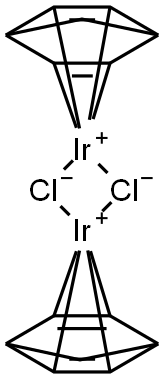
- 12111-11-4
- C14H8Cl2Ir2
- 631.55
- All (0)
- China (0)
- (0)
-
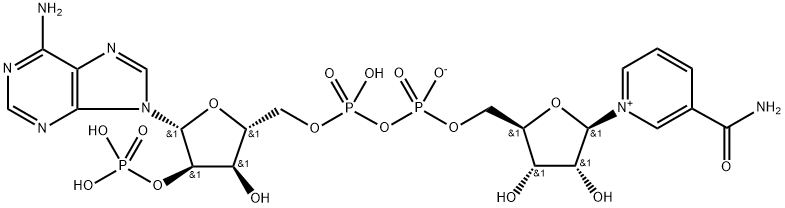
- 53-59-8
- C21H28N7O17P3
- 743.41
- All (1)
- China (0)
- (1)
-
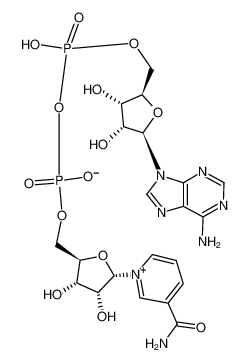
- 7298-93-3
- C21H27N7O14P2
- 663.43000
- All (0)
- China (0)
- (0)
-
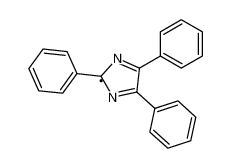
- 35398-30-2
- C21H15N2
- 295.35700
- All (0)
- China (0)
- (0)
-

- 1239587-38-2
- C17H14N2O3
- 294.30500
- All (0)
- China (0)
- (0)
-
- 682753-01-1
- C41H43N7O6
- 729.82300
- All (0)
- China (0)
- (0)
-
- 682753-04-4
- C21H28N4O7
- 448.47000
- All (0)
- China (0)
- (0)
-
- 139373-97-0
- C17H26N6O6
- 410.42500
- All (0)
- China (0)
- (0)
-
- 1135221-02-1
- C15H31N3O13P2
- 523.36600
- All (0)
- China (0)
- (0)
-
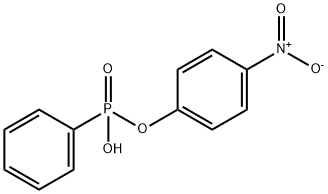
- 57072-35-2
- C12H10NO5P
- 279.19
- All (0)
- China (0)
- (0)
Related ProductsMore >
-
-
-
-
-
- 53-84-9
- Request For Quotation
- -
-
- 1184-16-3
- Request For Quotation
- 25kg/drum25kg/drum
-
- 24292-60-2
- Request For Quotation
- 25kg/drum25kg/drum
-
- 104809-32-7
- Request For Quotation
- 25kg/drum25kg/drum
 沪ICP备2021018848号-5


In DNA, these nucleotides connect in long chains to form the famous double helix structure. In RNA, they form a single chain. What’s cool is that the sequence of these bases acts like a code, telling cells how to make proteins — kind of like how letters form words that carry meaning.
You actually see the results of nucleotides every day — in your hair color, your height, and even your health. All those traits come from how DNA’s nucleotide sequence stores and passes genetic information. So when we ask “what is nucleic acids monomer called,” the short answer is “nucleotide,” but behind that word is the code of life itself 💡
The primary function of these monomers extends far beyond mere structural links. The specific sequence of the nitrogenous bases along the polynucleotide chain constitutes a genetic code, a set of instructions that directs the synthesis of every protein within an organism. This flow of information from nucleotide sequence to functional protein is a central dogma of molecular biology. The polymerization of nucleotides is not a random process but is governed by stringent enzymatic machinery, such as DNA polymerase during replication and RNA polymerase during transcription. These processes rely on the precise Watson-Crick base pairing rules, where adenine pairs with thymine (or uracil in RNA) and guanine pairs with cytosine, ensuring the high-fidelity transmission of genetic data from one generation to the next and from DNA to RNA.
From a broader perspective, the significance of nucleotides permeates numerous scientific and practical domains. In medicine, understanding nucleotide sequences and their alterations, known as mutations, is fundamental to diagnosing genetic disorders, developing targeted therapies, and tracing the origins of pathogens like viruses. The entire field of genomics is built upon deciphering the language of these monomers. In biotechnology, synthetic nucleotides are utilized in techniques like polymerase chain reaction (PCR) to amplify specific DNA segments, enabling everything from forensic analysis to biomedical research. Furthermore, nucleotides and their derivatives, such as ATP (adenosine triphosphate), are universal energy currency molecules, powering countless biochemical reactions in all known life forms, while cyclic AMP (cAMP) acts as a vital secondary messenger in cellular signaling pathways. The versatility of these monomers, from encoding the blueprint of life to fueling its processes, underscores their indispensable role in the biological world.
Nucleotides polymerize to form nucleic acids through the formation of phosphodiester bonds, which connect the 5’ phosphate group of one nucleotide to the 3’ hydroxyl group of an adjacent nucleotide, creating a linear chain with a defined 5’-to-3’ directionality. Beyond building nucleic acids, nucleotides serve essential non-structural roles: adenosine triphosphate (ATP), a nucleotide derivative, acts as the cell’s primary energy currency, powering metabolic reactions; cyclic adenosine monophosphate (cAMP) functions as a second messenger in signal transduction; and guanosine triphosphate (GTP) supports protein synthesis and cell division.
A key point of confusion is distinguishing nucleotides from nucleosides, which contain only the sugar and base (no phosphate group)—nucleosides cannot form phosphodiester bonds and thus cannot act as nucleic acid monomers. In专业 fields like molecular biology, genetics, and biochemistry, understanding nucleotide properties is indispensable: it enables the study of DNA replication (where nucleotides are added to growing strands by DNA polymerases), transcription (RNA synthesis from DNA templates), and technologies like polymerase chain reaction (PCR), which uses synthetic nucleotides to amplify specific DNA segments. Without nucleotides, the storage, transmission, and expression of genetic information—processes that define life—would be impossible.