


 Home
HomeWhat Are the Building Block of Nucleic Acids and Why Do They Matter?
Hey there, I’ve been reading about DNA and RNA lately, and I keep coming across the phrase “building block of nucleic acids.” I understand that these structures are important for life, but I’m not exactly sure what this term really means. Are these building blocks chemicals, molecules, or something else entirely? Could you explain in a simple way what people mean when they say the building block of nucleic acids?
Related Encyclopedia
-
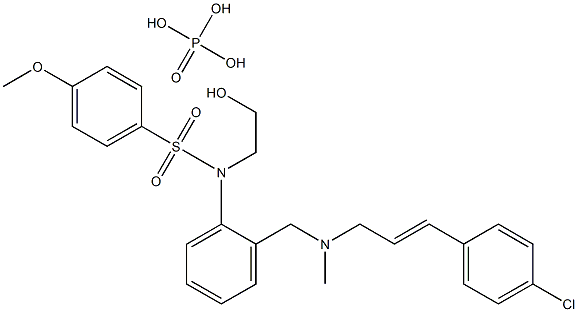
- 1188890-41-6
- C26H32ClN2O8PS
- 599.032641
- All (0)
- China (0)
- (0)
-
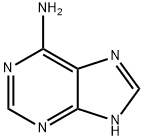
- 73-24-5
- C5H5N5
- 135.13
- All (119)
- China (18)
- (119)
-
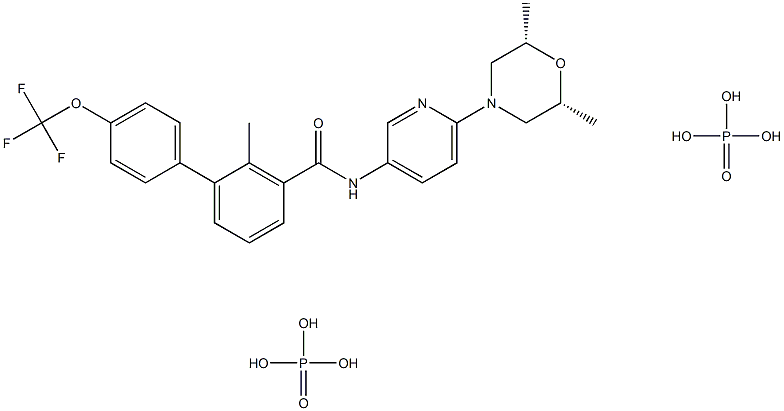
- 1218778-77-8
- C26H32F3N3O11P2
- 681.4885116
- All (0)
- China (0)
- (0)
-
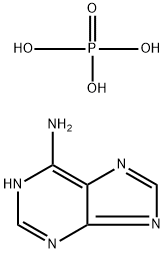
- 52175-10-7
- C5H8N5O4P
- 233.12
- All (0)
- China (0)
- (0)
-
![[(1R,2R,3S,4S)-2,3,4-trihydroxy-4-(hydroxymethyl)cyclopentyl]methyl dihydrogen phosphate](https://chemcloud-1304660855.cos.ap-shanghai.myqcloud.com/compound/3fb030b56d624f4cb160310e8c32a607.png?imageMogr2/format/webp)
- 101932-65-4
- C7H15O8P
- 258.16300
- All (0)
- China (0)
- (0)
-

- 139373-97-0
- C17H26N6O6
- 410.42500
- All (0)
- China (0)
- (0)
-
- 1135221-02-1
- C15H31N3O13P2
- 523.36600
- All (0)
- China (0)
- (0)
-
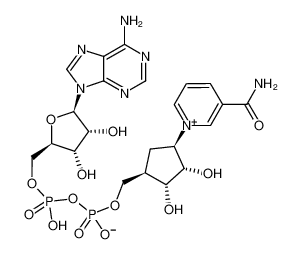
- 112345-60-5
- C22H29N7O13P2
- 661.45200
- All (0)
- China (0)
- (0)
-
![disodium,[(5R)-3-[3-fluoro-4-[6-(2-methyltetrazol-5-yl)pyridin-3-yl]phenyl]-2-oxo-1,3-oxazolidin-5-yl]methyl phosphate](https://chemcloud-1304660855.cos.ap-shanghai.myqcloud.com/compound/a268f58ebc1a43c494ed4c2b0f6dd4e9.png?imageMogr2/format/webp)
- 856867-39-5
- C17H14FN6Na2O6P
- 494.28100
- All (0)
- China (0)
- (0)
-
- 29789-55-7
- C21H27N6O17P3
- 728.39000
- All (0)
- China (0)
- (0)
Related ProductsMore >
-
- 10124-56-8
- Request For Quotation
- -
-
-
-
-
-
- 7722-88-7
- Request For Quotation
- -
-
- 7722-88-6
- Request For Quotation
- -
-
- 7722-88-5
- Request For Quotation
- -
 沪ICP备2021018848号-5


You don’t need to imagine complicated chemistry here. It’s more like beads on a string. The sugar and phosphate make the string, while the bases are the colorful beads carrying the information. That’s how your body stores instructions for everything it does, from eye color to how your cells grow.
Every time you grow, heal, or even just make new cells, your body is using these nucleotide building blocks to copy and pass along information. So in simple terms, nucleotides are the tiny pieces that, when joined, create the code of life.
In a biochemical context, nucleotides are not just structural units but also carriers of genetic information. The specific sequence of nitrogenous bases encodes instructions for protein synthesis and cellular regulation. This distinguishes nucleotides from simple molecules such as amino acids or monosaccharides, which are building blocks of proteins and polysaccharides, respectively, but do not store or transmit information in the same way. Confusion sometimes arises when people equate “building blocks of life” across different biomolecules, but it is important to recognize that nucleotides have a unique informational role.
From a physiological perspective, the way nucleotides polymerize into DNA or RNA chains underpins critical processes such as replication, transcription, and translation. Without accurate pairing of complementary bases, the integrity of genetic information would collapse, leading to cellular dysfunction. In engineering or applied sciences, this principle has been adapted in biotechnology, where nucleotides are manipulated for sequencing, gene editing, or synthetic biology. The predictability of base pairing makes nucleotides indispensable for techniques like PCR amplification or CRISPR-based modifications.
It is also worth clarifying that while nucleosides resemble nucleotides, they lack the phosphate group and therefore cannot form nucleic acid polymers independently. This distinction highlights the importance of the phosphate in creating stable linkages and directional strands. Overall, nucleotides as the building blocks of nucleic acids combine chemical stability, structural functionality, and informational capacity in a way no other biomolecular subunit does, which explains their central role across molecular biology and applied fields.
The architectural genius of nucleotides extends beyond their linear sequence into the realm of three-dimensional structure. The specific chemical properties of these building blocks enable the iconic DNA double helix. The nitrogenous bases exhibit complementary pairing: adenine with thymine (or uracil in RNA) via two hydrogen bonds, and guanine with cytosine via three. This specificity is not merely a structural curiosity but the fundamental mechanism for hereditary fidelity. The stable, information-dense double helix of DNA is ideal for long-term genetic storage, whereas the often single-stranded nature of RNA, also a polymer of nucleotides, allows it to fold into complex shapes capable of diverse functions, from messenger (mRNA) to catalytic ribozyme.
This molecular logic of nucleotide assembly has transcended biology to become a cornerstone of modern technology. The very principle of complementary base pairing is harnessed in the polymerase chain reaction (PCR), a technique that has revolutionized diagnostics, forensics, and biomedical research. In medicine, synthetic nucleotides and their analogs are deployed as powerful tools. Antiviral drugs like acyclovir and cancer therapeutics such as 5-fluorouracil are chemically engineered nucleotides that masquerade as their natural counterparts, disrupting the replication of viral or cancerous DNA. Furthermore, the entire field of genetic engineering, from producing life-saving insulin in bacteria to developing mRNA vaccines, is predicated on our ability to understand, manipulate, and synthesize these fundamental building blocks.
From a broader chemical perspective, nucleotides are not merely static letters in a genetic code but dynamic cellular regulators. The molecule ATP (adenosine triphosphate), essentially a nucleotide with extra phosphate groups, is the universal energy currency of the cell. The hydrolysis of its phosphate bonds releases energy that drives countless biological processes. Other nucleotide derivatives, like cyclic AMP (cAMP), act as crucial second messengers, relaying signals from hormones outside the cell to trigger specific responses within. This functional versatility underscores that nucleotides are multipurpose components, their roles evolving from information carriers to energy transducers and signaling molecules, a testament to their foundational role in the chemistry of life.
The industrial and environmental applications of nucleotide chemistry are also rapidly expanding. Biosensors utilizing DNA sequences can detect pathogens or environmental contaminants with exceptional sensitivity. Meanwhile, scientists are exploring the use of synthetic nucleic acids (XNAs) with altered sugar-phosphate backbones for data storage, offering a potential medium with unparalleled density and longevity compared to traditional electronic systems. The intricate dance of these molecular building blocks, from guiding the development of a single cell to enabling global technological advancements, continues to reveal new layers of complexity and utility, demonstrating that the deepest scientific insights often arise from understanding the most fundamental components.