


 Home
Home
You probably know that proteins are made up of amino acids, but have you ever wondered what actually makes one amino acid different from another? Is it their size, the way they behave, or something else entirely? How can such tiny building blocks have so many variations, and why does that matter for things like food, exercise, or even how our bodies work every day?
What Makes Each Amino Acid Unique?
Related Encyclopedia
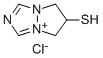
- 153851-71-9
- C5H8ClN3S
- 177.66
- All (10)
- China (3)
- (10)
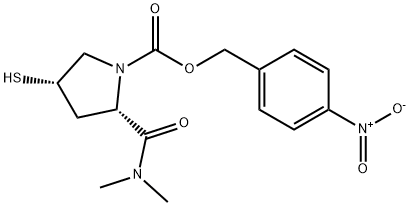
- 96034-64-9
- C15H19N3O5S
- 353.39
- All (19)
- China (0)
- (19)
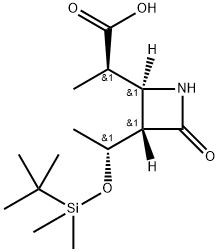
- 90776-58-2
- C14H27NO4Si
- 301.46
- All (13)
- China (0)
- (13)
- 192268-41-0
- CN2O2
- 72.02290
- All (0)
- China (0)
- (0)
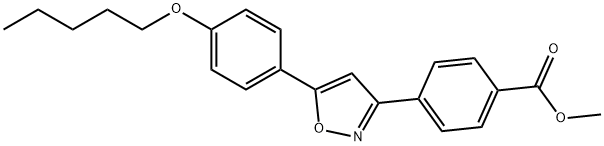
- 179162-64-2
- C22H23NO4
- 365.42
- All (0)
- China (0)
- (0)
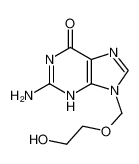
- 141294-79-3
- C8H11N5O3
- 225.20500
- All (1)
- China (0)
- (1)
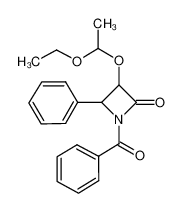
- 133066-61-2
- C20H21NO4
- 339.39000
- All (0)
- China (0)
- (0)

- 17778-88-0
- N
- 14.00670
- All (0)
- China (0)
- (0)
- 134661-75-9
- N20
- 280.13400
- All (2)
- China (2)
- (2)
![TRYPTOPHAN, L-, [SIDE CHAIN 1-14C]](https://chemcloud-1304660855.cos.ap-shanghai.myqcloud.com/compound/c189266ca3da44458b41a621893a8613.png?imageMogr2/format/webp)
- 7762-51-8
- C11H12N2O2
- 206.24000
- All (0)
- China (0)
- (0)
Related Products More >

- CNY Request For Quotation
- CNY Request For Quotation
- CNY Request For Quotation
- 112945-52-5
- Request For Quotation
- 7440-44-0
- Request For Quotation
- Request For Quotation
- 72-18-4
- USD 45.0000
- 25kg
- 74-79-3
- USD 92.0000
- 25kg
 沪ICP备2021018848号-5


These fundamental properties directly determine a protein’s final three-dimensional structure and function. Hydrophobic side chains tend to cluster in the protein’s interior, driving protein folding, while hydrophilic residues remain on the surface, interacting with water. The specific arrangement of different side chains creates active sites for enzymatic reactions or binding pockets for ligands. A single change, like substituting valine for glutamate in hemoglobin, alters the local chemical environment and is the primary cause of sickle cell anemia, demonstrating how a unique amino acid identity can have profound physiological consequences.
Beyond structure, this diversity enables amino acids to perform specialized roles. The hydroxyl group on tyrosine’s side chain allows it to be phosphorylated, a key mechanism in cellular signaling pathways that control processes like growth and metabolism. Glycine, with its minimal hydrogen atom as a side chain, provides exceptional flexibility in polypeptide chains, often found in the tight turns of protein structures. The uniqueness of each amino acid is therefore the foundational alphabet that allows for the vast functional lexicon of proteins, from antibodies to actin filaments.
Unlike the uniform backbone composed of repeating amine and carboxyl groups, the R-group’s variability allows amino acids to serve distinct roles in biological systems. For example, cysteine’s thiol group enables disulfide bond formation, critical for stabilizing extracellular proteins like antibodies, whereas histidine’s imidazole ring acts as a pH sensor in enzyme active sites. This specificity contrasts with non-standard amino acids, such as selenocysteine or pyrrolysine, which are incorporated into proteins via specialized machinery and expand functional diversity beyond the 20 canonical amino acids. A common misconception is that amino acids differ only in size; in reality, even minor variations in R-group chemistry—like the methyl group in alanine versus the hydroxyl in serine—can profoundly alter protein dynamics and function.
In biotechnology, understanding amino acid uniqueness is pivotal for protein engineering. Rational design strategies leverage side-chain properties to optimize catalysts, stabilize therapeutics, or create novel biomaterials. For instance, replacing hydrophobic residues with charged ones in a protein’s core can disrupt folding, while introducing cysteines at strategic positions enables site-specific conjugation of drugs or fluorescent tags. Missteps here, such as overlooking steric clashes or electrostatic repulsion, often lead to inactive or aggregation-prone variants. Thus, the R-group’s identity is not merely a chemical quirk but a blueprint for molecular behavior, shaping everything from evolutionary adaptation to industrial bioprocessing.
Another layer of distinction lies in how amino acids are metabolized. While all share common degradation pathways, certain side chains demand unique enzymes. For example, branched-chain amino acids like leucine require specialized transaminases, and aromatic amino acids undergo oxidative deamination via distinct dehydrogenase complexes. These metabolic divergences influence nutrient utilization, energy production, and even neurotransmitter synthesis, as seen in tyrosine’s role as a precursor to dopamine. Overlooking these differences can lead to flawed models of metabolic flux or misinterpretations of disease biomarkers, underscoring the need for precise amino acid characterization in both basic and applied sciences.
From a physiological perspective, the unique properties of amino acids determine how proteins interact with water, lipids, and other molecules. Hydrophilic side chains attract water and can form hydrogen bonds, which is essential for soluble proteins in blood and cytoplasm. Hydrophobic side chains avoid water, promoting the formation of stable cores within folded proteins. Some side chains are acidic or basic, influencing local pH and ionic interactions, which can modulate protein activity and interaction networks.
In practical contexts, the uniqueness of amino acids is leveraged in biotechnology, pharmaceuticals, and nutrition. For instance, modifying specific amino acids in enzymes can alter their stability, substrate specificity, or reaction rate, which is critical in industrial enzyme design or drug development. Nutritionally, understanding which amino acids are essential—meaning the body cannot synthesize them—guides dietary recommendations and the formulation of protein supplements. In biomedical applications, mutations altering key amino acids can disrupt protein function, contributing to disease, which underlines the clinical significance of precise amino acid composition.
Beyond biochemistry, these unique properties intersect with materials science and synthetic biology. Polymers and protein-based materials exploit side chain chemistry to achieve desired mechanical, thermal, or chemical properties. In all these contexts, the small structural differences among amino acids translate into large-scale effects, shaping molecular behavior, organismal physiology, and technological applications in ways that are both subtle and profound.