


 Home
Home
I’ve always wondered about the process behind creating calcium carbide. How exactly do factories or labs turn basic raw materials into this chemical? What are the main steps involved, and why does it react the way it does with water? Are there any simple ways to understand its production without diving too deep into chemistry books? How do people actually make it in practice, and what should someone know about it if they’re curious about everyday uses like in fireworks or lamps?
How Is Calcium Carbide Made?
Related Encyclopedia
- 75-20-7
- C2Ca
- 64.1
- All (13)
- China (7)
- (13)
- 12323-41-0
- CaO
- 58.07720
- All (164)
- China (21)
- (164)
- 141219-98-9
- C36
- 432.38500
- All (95)
- China (15)
- (95)

- 74-86-2
- C2H2
- 26.04
- All (5)
- China (5)
- (5)
- 188528-77-0
- Ca2O2
- 112.15500
- All (0)
- China (0)
- (0)
- 627-34-9
- C3S2
- 100.16200
- All (0)
- China (0)
- (0)

- 91948-87-7
- C3H3
- 39.05590
- All (0)
- China (0)
- (0)

- 84654-89-7
- CH2N
- 28.03330
- All (0)
- China (0)
- (0)

- 14067-05-1
- C+
- 12.01070
- All (0)
- China (0)
- (0)
- 4095-13-0
- CH2P
- 45.00030
- All (0)
- China (0)
- (0)
Related Products More >

- CNY Request For Quotation
- CNY Request For Quotation
- CNY Request For Quotation
- 112945-52-5
- Request For Quotation
- 7440-44-0
- Request For Quotation
- Request For Quotation
- 1305-78-8
- USD 135.0000
- 1ton
- 616-38-6
- CNY 3500.0000
- 1ton
 沪ICP备2021018848号-5


The electrochemical nature of calcium carbide production distinguishes it from other carbide synthesis processes, such as the formation of aluminum carbide (Al₄C₃) or silicon carbide (SiC), which may rely on different reactants or lower temperature ranges. Unlike SiC, which is synthesized using silica (SiO₂) and carbon at around 1600°C–1800°C and is valued for its hardness and thermal stability, calcium carbide’s production demands significantly higher temperatures due to the higher bond dissociation energy of CaO compared to SiO₂. This key difference in reaction conditions directly influences the industrial infrastructure required: calcium carbide furnaces are larger, consume more electrical power, and are designed to handle the intense heat and gas evolution, whereas SiC production can use simpler resistance furnaces in some cases.
A common misconception about calcium carbide is that it is produced using limestone (CaCO₃) directly, but this is incorrect because limestone must first be calcined—heated to around 900°C–1000°C—to decompose into calcium oxide and carbon dioxide. Using uncalcined limestone would introduce unnecessary carbon dioxide into the reaction chamber, which could react with carbon to form carbon monoxide, increasing energy consumption and reducing product yield. Another misunderstanding is equating calcium carbide’s reactivity with water to that of other metal carbides; while many carbides react with water to produce hydrocarbons, calcium carbide specifically forms acetylene (C₂H₂) and calcium hydroxide (Ca(OH)₂), a reaction that is both exothermic and highly efficient, making it the primary industrial source of acetylene.
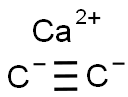
In professional fields, calcium carbide’s importance is multifaceted, particularly in chemical manufacturing and metallurgy. Acetylene derived from calcium carbide serves as a feedstock for producing vinyl chloride (used in PVC production),Calcium carbide, chemically represented as CaC₂, is synthesized through a high-temperature electrochemical reaction that primarily involves calcium oxide (CaO), commonly known as quicklime, and carbonaceous materials such as coke, anthracite, or petroleum coke. The process is conducted in an electric arc furnace, which is essential for achieving the extreme temperatures—typically between 2000°C and 2200°C—required to drive the endothermic reaction. In this furnace, electrodes pass an electric current through the mixture of CaO and carbon, generating an arc that provides the necessary thermal energy to break the stable bonds in the reactants and form new compounds. The core chemical reaction can be expressed as CaO + 3C → CaC₂ + CO, where carbon monoxide (CO) is released as a byproduct, which is often captured and used as a fuel source in industrial settings to improve energy efficiency.
The electrochemical nature of calcium carbide production distinguishes it from other carbide synthesis processes, such as the formation of aluminum carbide (Al₄C₃) or silicon carbide (SiC), which may rely on different reactants or lower temperature ranges. Unlike SiC, which is synthesized using silica (SiO₂) and carbon at around 1600°C–1800°C and is valued for its hardness and thermal stability, calcium carbide’s production demands significantly higher temperatures due to the higher bond dissociation energy of CaO compared to SiO₂. This key difference in reaction conditions directly influences the industrial infrastructure required: calcium carbide furnaces are larger, consume more electrical power, and are designed to handle the intense heat and gas evolution, whereas SiC production can use simpler resistance furnaces in some cases.
A common misconception about calcium carbide is that it is produced using limestone (CaCO₃) directly, but this is incorrect because limestone must first be calcined—heated to around 900°C–1000°C—to decompose into calcium oxide and carbon dioxide. Using uncalcined limestone would introduce unnecessary carbon dioxide into the reaction chamber, which could react with carbon to form carbon monoxide, increasing energy consumption and reducing product yield. Another misunderstanding is equating calcium carbide’s reactivity with water to that of other metal carbides; while many carbides react with water to produce hydrocarbons, calcium carbide specifically forms acetylene (C₂H₂) and calcium hydroxide (Ca(OH)₂), a reaction that is both exothermic and highly efficient, making it the primary industrial source of acetylene.
In professional fields, calcium carbide’s importance is multifaceted, particularly in chemical manufacturing and metallurgy. Acetylene derived from calcium carbide serves as a feedstock for producing vinyl chloride (used in PVC production), acrylonitrile (for synthetic fibers), and other organic compounds. In metallurgy, it acts as a deoxidizer and desulfurizer in steel production, where it reacts with oxygen and sulfur impurities to form volatile compounds that can be removed, improving the steel’s quality. Additionally, in regions with limited access to natural gas, calcium carbide remains a critical source of acetylene for welding and cutting, as it provides a portable and concentrated form of energy that does not require a continuous gas supply. Its role in these industries underscores its enduring relevance, even as alternative processes for acetylene production (such as steam cracking of hydrocarbons) have become more prevalent in areas with abundant natural gas reserves.
From a chemical perspective, calcium carbide functions as a convenient source of acetylene, which has wide-ranging applications. In industry, it serves as a precursor for synthetic organic compounds, including plastics, solvents, and various chemical intermediates. In metallurgy, acetylene derived from calcium carbide is used for welding and cutting due to its high flame temperature. The physical mechanism involves the release of gas upon hydrolysis, a reaction governed by acid-base and redox principles, producing energy and gas expansion. This reaction exemplifies how simple compounds can be leveraged to perform useful mechanical and chemical work.
Beyond industrial use, calcium carbide intersects with environmental and daily-life applications. In agriculture, carbide-generated acetylene can be used for fruit ripening, while in energy and lighting, its role in acetylene lamps represents early chemical engineering achievements. Understanding its synthesis also provides insight into the broader field of high-temperature inorganic chemistry, where thermodynamics and reaction kinetics determine material formation and utility. Recognizing these principles allows chemists and engineers to innovate safer, more efficient processes, balancing reactivity with control.
The broader significance of calcium carbide extends to its educational and technological implications. It illustrates the conversion of raw earth materials into functional compounds, highlighting the connection between chemistry, materials science, and industry. Observing its behavior, both in production and in practical applications, emphasizes the importance of chemical reactivity and energy management, providing a foundation for both academic inquiry and real-world technological solutions.
The resulting calcium carbide exhibits a critical property: it generates acetylene gas upon contact with water. This reaction, CaC₂ + 2H₂O → C₂H₂ + Ca(OH)₂, makes it invaluable in various applications. For instance, in metal fabrication, acetylene serves as a high-temperature fuel gas for welding and cutting torches due to its intense flame. Another example is its historical use in carbide lamps, where controlled water dripping onto calcium carbide produced illumination for mining and spelunking before electric lights became widespread.
Handling calcium carbide requires strict safety protocols because of its moisture sensitivity. It must be stored in airtight containers to prevent unintended reactions with atmospheric humidity, which could lead to hazardous acetylene accumulation. In chemical manufacturing, its role as a precursor for synthetic resins and solvents underscores its industrial significance. The material’s utility persists despite advancements, particularly in regions where acetylene-based processes remain economically advantageous for specific chemical syntheses or specialized metalworking tasks.