


 Home
Home
Hi, I'd like to ask—Are oxalic acid, sodium carbonate, and alcohol polar or nonpolar compounds? How does molecular structure determine polarity? Does the polarity of these compounds affect their solubility in water or other solvents? For example, why does sodium carbonate dissolve easily in water while alcohol has limited solubility? Thanks!
Are Oxalic Acid, Sodium Carbonate, and Alcohol Polar or Nonpolar Compounds? Analysis of Molecular Polarity and Structure
Related Encyclopedia
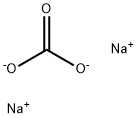
- 497-19-8
- CH2O3.2Na
- 105.99
- All (113)
- China (64)
- (113)
- 33058-12-7
- C12H8Cl6O
- 380.90900
- All (0)
- China (0)
- (0)
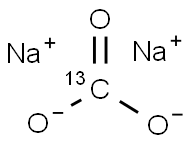
- 93673-48-4
- CNa2O3
- 107
- All (0)
- China (0)
- (0)
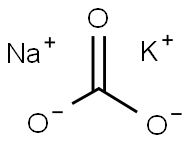
- 10424-09-6
- CKNaO3
- 122.1
- All (0)
- China (0)
- (0)
- 16482-55-6
- CH2AlNaO5
- 143.99500
- All (0)
- China (0)
- (0)
- 5968-11-6
- CH5NaO4
- 104.04
- All (7)
- China (4)
- (7)
- 24551-51-7
- CH20Na2O13
- 286.14
- All (3)
- China (1)
- (3)

- 68603-87-2
- C2H2O4
- 90.03
- All (446)
- China (35)
- (446)
- 57127-86-3
- CNaNpO5
- 351.99700
- All (0)
- China (0)
- (0)
- 7404-49-1
- C7H16N2O4
- 192.21300
- All (0)
- China (0)
- (0)
Related Products More >

- CNY Request For Quotation
- CNY Request For Quotation
- CNY Request For Quotation
- CNY Request For Quotation
- CNY Request For Quotation
- CNY Request For Quotation
- CNY Request For Quotation
- CNY Request For Quotation
 沪ICP备2021018848号-5


Sodium Carbonate
Sodium carbonate is an ionic compound, which means it consists of positively charged sodium ions and negatively charged carbonate ions . Although it is not covalent, ionic compounds can be considered highly polar due to the significant separation of charge. Sodium carbonate dissolves easily in water because the polar water molecules can separate and surround the ions, stabilizing them in solution.
Ethanol
Ethanol is a polar compound. Its molecular structure includes a hydroxyl group , which is polar due to the difference in electronegativity between oxygen and hydrogen. The oxygen atom in the hydroxyl group attracts electrons more strongly than hydrogen, creating a dipole moment. This polarity allows ethanol to form hydrogen bonds with water, making it soluble in water.
How Molecular Structure Determines Polarity
Polarity and Electronegativity
Polarity in molecules arises from differences in electronegativity between the atoms involved in covalent bonds. Electronegativity is a measure of an atom's ability to attract electrons in a bond. When atoms with different electronegativities bond, the electrons are not shared equally, resulting in a polar bond.
Dipole Moments
A dipole moment occurs when there is a separation of charge within a molecule. In polar molecules, the centers of positive and negative charge do not coincide, leading to a net dipole moment. For example, in ethanol, the oxygen atom in the hydroxyl group attracts electrons more strongly than the hydrogen atoms, creating a partial negative charge on the oxygen and partial positive charges on the hydrogens.
Molecular Geometry
The overall shape of the molecule also plays a role in determining its polarity. Even if individual bonds are polar, the molecule may be nonpolar if the dipole moments cancel each other out due to symmetry. For example, carbon dioxide has polar bonds but is a linear molecule, so the dipole moments cancel out, making it nonpolar.
How Polarity Affects Solubility
Solubility in Water
Water is a highly polar solvent, and it tends to dissolve other polar substances and ionic compounds. This is described by the principle "like dissolves like."
Oxalic Acid: The polar carboxyl groups in oxalic acid form hydrogen bonds with water molecules, making it soluble in water.
Sodium Carbonate: As an ionic compound, sodium carbonate dissociates into Na⁺ and CO₃²⁻ ions in water. The polar water molecules surround and stabilize these ions, making sodium carbonate highly soluble in water.
Ethanol: The polar hydroxyl group in ethanol forms hydrogen bonds with water molecules, allowing ethanol to dissolve in water. However, the hydrocarbon part of ethanol is nonpolar, which limits its solubility in water compared to smaller alcohols like methanol.
Solubility in Nonpolar Solvents
Nonpolar solvents, such as hexane or benzene, tend to dissolve nonpolar compounds. Since oxalic acid, sodium carbonate, and ethanol are polar or ionic, they generally have low solubility in nonpolar solvents.
Why Sodium Carbonate Dissolves Easily in Water While Ethanol Has Limited Solubility
Sodium Carbonate
Sodium carbonate is an ionic compound that dissociates completely into Na⁺ and CO₃²⁻ ions in water. The polar water molecules can easily separate and surround these ions, forming hydration shells that stabilize them in solution. This process is highly favorable energetically, making sodium carbonate very soluble in water.
Ethanol
Ethanol is a polar molecule due to its hydroxyl group, which can form hydrogen bonds with water. However, it also has a nonpolar hydrocarbon chain . While the hydroxyl group promotes solubility, the hydrocarbon chain resists dissolution in water. This dual nature results in ethanol being soluble in water, but its solubility is limited compared to smaller alcohols like methanol, which have a higher proportion of polar character relative to their size.
Conclusion
Oxalic acid, sodium carbonate, and ethanol are all polar or ionic compounds, but their solubility in water and other solvents is influenced by their molecular structures. Oxalic acid and ethanol are polar due to the presence of polar functional groups , while sodium carbonate is an ionic compound that dissociates into ions in solution. The polarity of these compounds allows them to interact favorably with polar solvents like water, leading to good solubility. However, the presence of nonpolar parts in ethanol limits its solubility compared to more polar compounds.
Understanding the relationship between molecular structure, polarity, and solubility helps explain why certain compounds dissolve easily in water while others do not. If you have any more questions or need further clarification, feel free to ask!
Oxalic acid , sodium carbonate , and ethanol are all polar compounds. Their polarity is determined by the presence of polar functional groups and the distribution of electron density within their molecular structures.
Case Study: Molecular Structure and Polarity
Oxalic Acid : A dicarboxylic acid with two carboxyl groups . The oxygen atoms in the carboxyl groups are highly electronegative, creating polar covalent bonds and a net dipole moment.
Sodium Carbonate : An ionic compound composed of Na⁺ ions and CO₃²⁻ ions. The carbonate ion is polar due to the presence of polar C=O bonds and the overall negative charge.
Ethanol : A polar molecule due to the presence of the hydroxyl group . The oxygen atom in the hydroxyl group is more electronegative than hydrogen, creating a polar bond and a net dipole moment.
Solubility in Water
The polarity of these compounds affects their solubility in water:
Oxalic Acid: Highly soluble in water due to the ability to form hydrogen bonds and partially dissociate into ions.
Sodium Carbonate: Highly soluble in water due to its ionic nature and strong ion-dipole interactions with water molecules.
Ethanol: Miscible with water in all proportions due to the ability to form hydrogen bonds with water molecules.
Solubility Differences
Sodium carbonate dissolves easily in water due to its ionic nature, while ethanol, though polar, has a nonpolar hydrocarbon chain that reduces its solubility in water compared to fully polar compounds like sodium carbonate.
Oxalic acid , sodium carbonate , and ethanol are all polar compounds. Their polarity is determined by the presence of polar functional groups and the distribution of electron density within their molecular structures.
Molecular Structure and Polarity
Oxalic Acid : Oxalic acid is a dicarboxylic acid with two carboxyl groups . The oxygen atoms in the carboxyl groups are highly electronegative, creating polar covalent bonds and a net dipole moment.
Sodium Carbonate : Sodium carbonate is an ionic compound composed of Na⁺ ions and CO₃²⁻ ions. The carbonate ion is polar due to the presence of polar C=O bonds and the overall negative charge.
Ethanol : Ethanol is a polar molecule due to the presence of the hydroxyl group . The oxygen atom in the hydroxyl group is more electronegative than hydrogen, creating a polar bond and a net dipole moment.
Solubility in Water
The polarity of these compounds affects their solubility in water:
Oxalic Acid: Highly soluble in water due to the ability to form hydrogen bonds and partially dissociate into ions.
Sodium Carbonate: Highly soluble in water due to its ionic nature and strong ion-dipole interactions with water molecules.
Ethanol: Miscible with water in all proportions due to the ability to form hydrogen bonds with water molecules.
Solubility Differences
Sodium carbonate dissolves easily in water due to its ionic nature, while ethanol, though polar, has a nonpolar hydrocarbon chain that reduces its solubility in water compared to fully polar compounds like sodium carbonate.