


 Home
Home
I’ve been wondering about methane and how it behaves when it’s released into the air. Does it float upwards like a balloon, or does it settle down closer to the ground? I know some gases behave differently depending on their weight compared to air, but I’m not sure where methane fits in. How does it move around in everyday situations, like near a gas leak or in a barn where animals produce it? Can it be dangerous because of this? So, does methane rise or sink when released?
Does Methane Rise or Sink? Understanding Its Behavior in Air
Related Encyclopedia
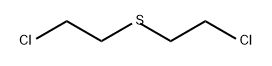
- 505-60-2
- C4H8Cl2S
- 159.08
- All (0)
- China (0)
- (0)
- 141219-98-9
- C36
- 432.38500
- All (95)
- China (15)
- (95)
- 53886-01-4
- C2D5F
- 53.09031
- All (0)
- China (0)
- (0)
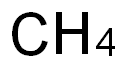
- 74-82-8
- CH4
- 16.04
- All (22)
- China (22)
- (22)
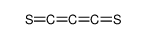
- 627-34-9
- C3S2
- 100.16200
- All (0)
- China (0)
- (0)

- 91948-87-7
- C3H3
- 39.05590
- All (0)
- China (0)
- (0)

- 84654-89-7
- CH2N
- 28.03330
- All (0)
- China (0)
- (0)

- 14067-05-1
- C+
- 12.01070
- All (0)
- China (0)
- (0)
- 4095-13-0
- CH2P
- 45.00030
- All (0)
- China (0)
- (0)
- 53590-27-5
- C2N
- 38.02810
- All (0)
- China (0)
- (0)
Related Products More >

- CNY Request For Quotation
- CNY Request For Quotation
- CNY Request For Quotation
- 101-68-8
- CNY Request For Quotation
- 101-68-8
- CNY Request For Quotation
- 101-68-8
- CNY Request For Quotation
- 9002-88-4
- Request For Quotation
- 112945-52-5
- Request For Quotation
 沪ICP备2021018848号-5


Once in the atmosphere, methane interacts with other gases and is influenced by weather patterns. It becomes well-mixed and spreads throughout the troposphere. Its movement is then governed more by atmospheric circulation and wind than by buoyancy alone. Despite its initial rise, it doesn't "sink" back down in a conventional sense but is instead dispersed and eventually broken down.
The primary removal mechanism is oxidation. Hydroxyl radicals in the atmosphere react with methane, breaking it down into carbon dioxide and water over a period of about 12 years. This process occurs predominantly in the lower atmosphere, preventing excessive accumulation. For instance, a methane leak from a natural gas pipeline will see the gas rise and spread, contributing to ground-level ozone formation before its eventual decomposition. Its potency as a greenhouse gas is directly tied to this atmospheric journey and chemical reactivity.
In the context of climate science and atmospheric chemistry, methane’s tendency to rise plays a key role in its global distribution and impact. Once released into the atmosphere, methane’s lower density causes it to ascend through the troposphere, where it interacts with other atmospheric components such as hydroxyl radicals (OH⁻) and ozone (O₃). This upward movement allows methane to spread more widely across the globe rather than remaining concentrated in the region of its emission, influencing its overall greenhouse effect. Methane is a potent greenhouse gas, with a global warming potential significantly higher than that of CO₂ over a 20-year timeframe, and its ability to rise ensures it contributes to climate forcing throughout the lower atmosphere. It is important to clarify a common misconception here: while methane rises in air, its movement is not absolute and can be influenced by external factors like wind turbulence, temperature inversions, or localized air currents. In a temperature inversion, for example, a layer of warmer air sits above cooler air near the ground, trapping denser cool air (and any gases within it) below—this can temporarily slow or even halt methane’s upward movement, leading to localized accumulation despite its inherent buoyancy. This nuance is vital for researchers and policymakers working on methane emission monitoring, as it affects how and where detection equipment should be placed to accurately measure releases.
In biological systems, such as anaerobic digestion processes used in wastewater treatment or biogas production, methane’s rising behavior is harnessed for practical applications. During anaerobic digestion, microorganisms break down organic matter in the absence of oxygen, producing a biogas mixture primarily composed of methane (50-70%) and carbon dioxide (30-50%). Since methane is less dense than both CO₂ and the surrounding liquid slurry in digestion tanks, it naturally separates and rises to the top of the tank, where it can be collected via gas capture systems. This separation is not just a byproduct of methane’s density but a core engineering principle that makes biogas recovery economically viable—without its tendency to rise, separating methane from the liquid and heavier gases would require more energy-intensive processes like membrane filtration or chemical scrubbing. Unlike other byproducts of anaerobic digestion, such as solid digestate (which sinks and is removed from the bottom of tanks), methane’s upward movement allows for continuous, passive collection, reducing operational costs and improving the efficiency of renewable energy production from organic waste. This distinction in behavior between methane and other components of the digestion system is essential for optimizing biogas plants, as it dictates the design of tank geometry, gas outlet placement, and mixing strategies to maximize methane yield.
This property of methane has practical implications across multiple contexts. In domestic and industrial environments, leaks from natural gas pipelines, stoves, or storage tanks will cause methane to move upwards, often accumulating near ceilings or confined upper spaces. Understanding this movement is critical for the design of gas detection and ventilation systems. For example, gas sensors are typically installed at higher points in rooms to detect methane effectively, and ventilation strategies prioritize removing gas from elevated zones to prevent dangerous concentrations. In large-scale industrial settings, such as chemical plants or refineries, the tendency of methane to rise influences safety protocols, emergency response planning, and the design of containment measures.
Beyond immediate safety considerations, methane’s buoyant behavior also affects environmental processes. In agriculture, methane generated from livestock or decomposing organic matter in manure pits will tend to rise, influencing how it interacts with local air currents and contributes to greenhouse gas accumulation in the atmosphere. In natural ecosystems, methane released from wetlands or permafrost areas disperses upward, affecting regional methane budgets and climate modeling. The dynamics of methane transport also intersect with engineering disciplines when designing systems for biogas capture, where the gas’s upward movement can be leveraged to efficiently collect and store it for energy use.
Taking a broader view, the rise of methane highlights the interplay between molecular properties and macroscopic behavior. Its low density compared to air, combined with its flammability, underscores the need for careful monitoring in both everyday and industrial contexts. Understanding how methane behaves in the vertical space of an environment informs safety practices, energy applications, and environmental modeling, emphasizing that a seemingly simple physical trait has far-reaching implications.